
Why Long-Term Furnace Performance Matters in Industrial Operations
In modern industrial manufacturing, Mesh Belt Conveyor Ovens play a crucial role in continuous heat treatment, drying, curing, tempering, annealing, and thermal processing applications. These ovens are widely used across industries such as automotive, fasteners, electronics, metallurgy, aerospace, and industrial component manufacturing, where uninterrupted production and thermal consistency are essential.
However, the long-term efficiency of a conveyor oven depends heavily on multiple operational and engineering factors. A well-designed oven can deliver reliable performance for years, while poor maintenance or improper operating conditions can significantly reduce equipment lifespan and increase downtime costs.
Understanding the key factors that influence the lifespan of a mesh belt conveyor oven helps industries improve operational efficiency, reduce maintenance expenses, and maximize production reliability.
Build Quality & Material Selection
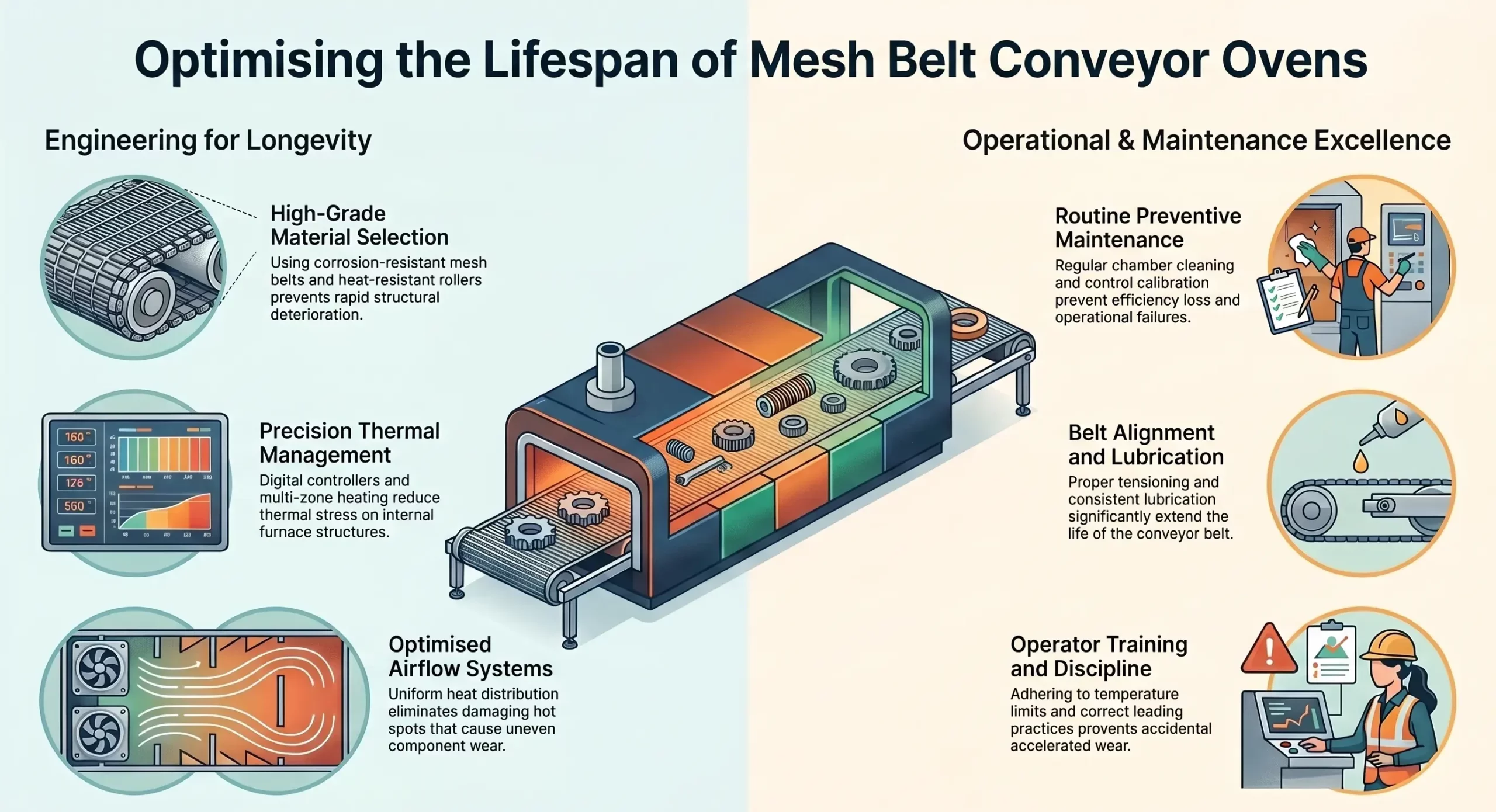
One of the most important factors affecting oven lifespan is the quality of construction materials used during manufacturing. Since conveyor ovens operate continuously under high temperatures, every component must withstand thermal stress, oxidation, and mechanical wear.
Critical areas include:
- High-temperature resistant insulation
- Durable stainless steel construction
- Corrosion-resistant mesh belts
- Heavy-duty drive systems
- Heat-resistant rollers and bearings
Low-grade materials often deteriorate rapidly under prolonged exposure to heat, leading to belt deformation, structural weakening, and inconsistent thermal performance.
High-quality industrial furnace systems designed with durable materials generally offer better thermal stability and longer operational life. Industrial furnaces are commonly engineered to withstand continuous thermal processing conditions through specialized refractory and heat-resistant materials.
Operating Temperature & Thermal Control
The way an oven operates daily directly affects its lifespan. Continuous operation beyond recommended temperature limits accelerates component wear and increases the risk of thermal damage.
Proper temperature uniformity and intelligent thermal management are essential for maintaining equipment durability. Excessive thermal cycling, uneven heating zones, or sudden temperature fluctuations can create stress on internal structures and conveyor systems.
Modern mesh belt ovens increasingly incorporate:
- Digital temperature controllers
- Automated thermal monitoring
- Precision airflow systems
- Multi-zone heating control
These technologies help maintain stable processing conditions while reducing thermal strain on furnace components.
Conveyor Belt Quality & Maintenance
The mesh conveyor belt itself is one of the most heavily used components in the entire system. Continuous movement under high temperatures and production loads subjects the belt to constant stress.
Several factors influence belt longevity, including:
- Product load weight
- Belt alignment
- Lubrication quality
- Heat exposure duration
- Material compatibility
Improper tension, poor alignment, or inadequate maintenance can lead to premature belt wear, stretching, or breakage.
Routine inspection and preventive maintenance significantly extend conveyor belt lifespan while minimizing unexpected shutdowns.
Airflow Efficiency & Heat Distribution
Proper airflow design is another critical factor determining oven durability and process consistency. Uneven airflow creates hot spots inside the chamber, leading to inconsistent heating and unnecessary stress on components.
Efficient airflow systems help:
- Maintain temperature consistency
- Improve thermal efficiency
- Reduce overheating risks
- Protect heating elements and insulation
Industrial thermal systems rely heavily on controlled heat transfer and airflow optimization to maintain stable process environments. Heat treatment systems often require precise thermal distribution for operational reliability and product quality.
Preventive Maintenance & Operational Practices
Even the most advanced conveyor oven requires proper maintenance to achieve maximum lifespan. Neglecting routine servicing can gradually reduce efficiency and increase operational failures.
Important maintenance practices include:
- Cleaning heating chambers regularly
- Inspecting belts and rollers
- Monitoring electrical systems
- Checking insulation integrity
- Calibrating temperature controls
Operator training also plays a major role. Improper loading practices, overheating, or ignoring warning signs can accelerate wear and significantly shorten equipment life.
Building Reliable & Long-Lasting Thermal Processing Systems
The lifespan of a Mesh Belt Conveyor Oven depends on a combination of engineering quality, thermal management, airflow efficiency, preventive maintenance, and operational discipline. Businesses that invest in well-designed furnace systems and follow proper maintenance practices can significantly improve productivity while reducing costly downtime and repairs. As industrial production demands greater precision and efficiency, durable conveyor oven systems remain essential for maintaining consistent, reliable manufacturing operations.
For industries seeking durable, high-performance thermal processing systems, Precons Furnaces delivers advanced industrial furnace solutions engineered for reliability, thermal efficiency, and long-term operational performance across demanding applications.