
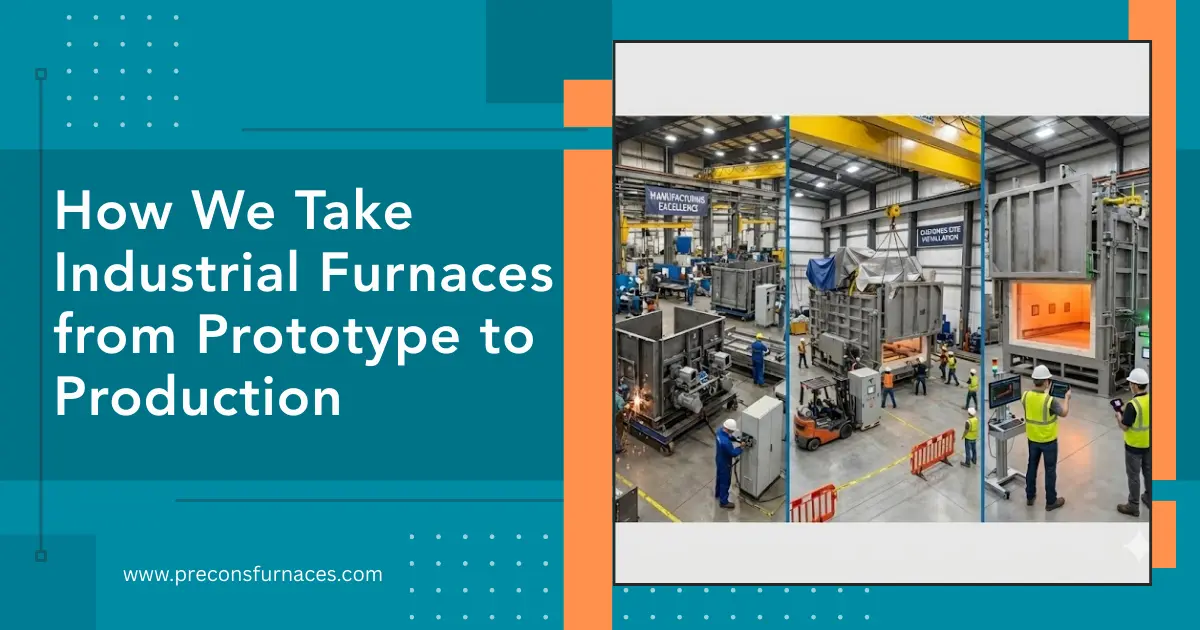
When a leading aerospace manufacturer contacts an industrial furnace supplier with unique heat treatment requirements, they’re not just buying equipment—they’re initiating a complex engineering journey that transforms application challenges into precision-engineered solutions. This journey, spanning months of collaboration and expertise, reveals why custom furnace development represents far more than simple equipment procurement.
Understanding this process helps manufacturers make informed decisions about custom versus standard furnace solutions, realistic project timelines, and the value of experienced engineering partnerships.
Phase 1: Discovery and Requirements Analysis
Every successful custom furnace project begins with a comprehensive understanding of the application. This critical phase involves:
Technical Requirements Definition:
- Component specifications – dimensions, weights, materials, and geometries
- Heat treatment parameters – temperature ranges, uniformity requirements, cycle times
- Atmosphere requirements – protective gases, vacuum levels, or air environments
- Production volume targets – batch sizes, throughput rates, operational schedules
Facility Integration Assessment:
- Available floor space and height clearances
- Utility infrastructure – electrical capacity, gas supplies, and cooling water
- Material handling systems – crane capacity, loading mechanisms, workflow integration
- Environmental compliance – emissions, noise levels, safety regulations
This discovery phase typically requires 2-4 weeks of detailed consultation between engineering teams, ensuring every application nuance is captured before design work begins.
Phase 2: Engineering Design and Optimization
Armed with comprehensive requirements, furnace engineers translate application needs into technical designs. This phase represents the creative core of custom furnace development:
Conceptual Design: Preliminary layouts explore multiple configuration approaches to determine optimal heating methods, chamber arrangements, loading systems, and control architectures. Engineers evaluate trade-offs between performance, cost, and operational complexity.
Detailed Engineering: Selected concepts evolve into complete technical specifications, including:
- Thermal modelling predicting temperature distributions and heating rates
- Structural calculations ensuring mechanical integrity under thermal loads
- Heating element selection optimizing energy efficiency and service life
- Control system architecture defining automation and monitoring capabilities
- Atmosphere system design, ensuring gas flow patterns and composition control
Design Review Cycles: Collaborative reviews with customers validate that designs meet application requirements while identifying opportunities for optimization. This iterative process typically spans 4-8 weeks, depending on project complexity.
Phase 3: Manufacturing and Quality Control
With approved designs, fabrication transforms engineering concepts into physical equipment:
Component Sourcing: Critical components—such as heating elements, refractory materials, control systems, and atmospheric equipment—are procured from qualified suppliers that meet specification requirements.
Fabrication Excellence: Skilled artisans execute precision manufacturing of furnace structures:
- Steel fabrication with exacting tolerances for thermal expansion
- Refractory installation following proven techniques for longevity
- Heating element mounting ensures proper support and electrical connections
- Instrumentation integration, positioning sensors for accurate measurement
Factory Testing: Before shipment, furnaces undergo comprehensive factory acceptance testing (FAT):
- Temperature uniformity surveys validating heating performance
- Control system verification confirming programming accuracy
- Safety system testing ensures that protective interlocks function properly
- Documentation review verifying completeness of operating manuals
The manufacturing and testing phases typically require 8-16 weeks, depending on furnace size and complexity.
Phase 4: Installation and Site Integration
On-site installation transforms delivered equipment into operational systems:
Foundation and Utilities:
- Structural foundations providing stable support
- Electrical connections matching local power specifications
- Gas and cooling systems integration with facility infrastructure
- Exhaust and ventilation ensuring environmental compliance
Mechanical Installation: Experienced installation teams position and assemble furnace components, ensuring alignment, clearances, and accessibility for operation and maintenance.
Installation duration: Typically 2-4 weeks, depending on furnace complexity and site readiness.
Phase 5: Commissioning and Validation
The journey culminates in comprehensive commissioning that validates performance:
System Startup:
- Sequential component activation following proven procedures
- Control system calibration ensures measurement accuracy
- Safety system verification confirming protective functions
Performance Qualification: Rigorous testing demonstrates that the furnace meets all specified requirements:
- Temperature uniformity testing throughout the working volume
- Atmosphere control validation for protective gas systems
- Process cycle execution confirming heating rates and cooling performance
- Production trial runs processing actual customer components
Operator Training: Comprehensive training sessions ensure production teams understand operation, routine maintenance, and troubleshooting procedures.
Commissioning typically requires 1-2 weeks, culminating in final acceptance and handover.
The Value of Experience
This 4-6 month journey from concept to commissioning demands coordinated expertise across disciplines. Manufacturers partnering with experienced furnace builders benefit from proven methodologies, established supplier networks, and decades of application knowledge that anticipate challenges before they impact timelines or performance.
Considering a custom furnace project for your unique application requirements? Precons Furnaces has guided 5100+ custom furnace projects from initial concept through successful commissioning over four decades. Our end-to-end engineering capabilities ensure your project delivers the performance, reliability, and quality your application demands.