
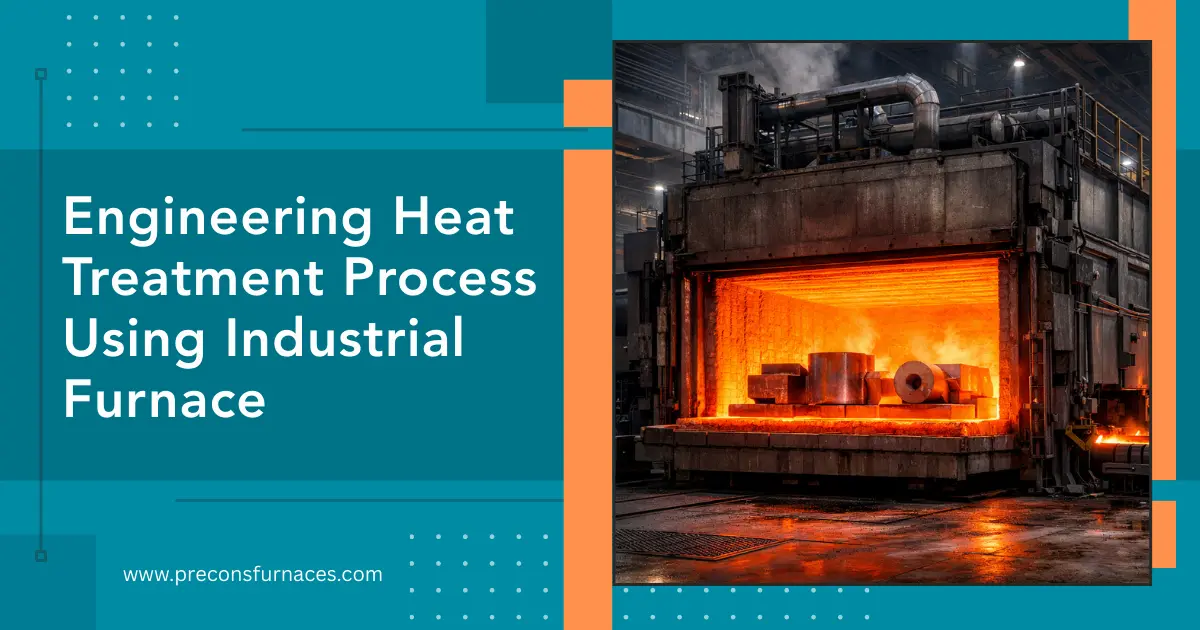
In modern manufacturing, industrial furnaces play a vital role in transforming raw metals into durable, high-performance components. From automotive parts to aerospace materials, heat treatment furnaces ensure metals achieve the required strength, hardness, ductility, and structural stability.
Heat treatment is a controlled process where metals are heated to specific temperatures and cooled at precise rates to change their mechanical properties. This process is essential for industries that require reliable and high-performance metal components.
Let’s explore how industrial furnaces work and why they are indispensable for modern heat treatment applications.
What Is an Industrial Furnace in Heat Treatment?
An industrial furnace is specialized equipment designed to heat materials—primarily metals—to extremely high temperatures under controlled conditions. These furnaces are used to perform various heat treatment processes that modify the internal structure of metals.
Common heat treatment processes performed in industrial furnaces include:
- Annealing – Softens metals and improves ductility
- Hardening – Increases metal strength and wear resistance
- Tempering – Reduces brittleness after hardening
- Normalizing – Refines grain structure and improves uniformity
- Nitriding and Carburizing – Enhances surface hardness and durability
These processes allow manufacturers to optimize the performance of metal components for demanding industrial applications.
Types of Industrial Furnaces Used in Heat Treatment
Different industries require different furnace designs depending on production volume, material type, and heat treatment requirements.
Some of the most commonly used furnaces include:
- Box Furnaces – Ideal for batch heat treatment of small to medium components
- Pit Furnaces – Suitable for long cylindrical parts such as shafts and bars
- Bell Furnaces – Used for controlled atmosphere heat treatment processes
- Bogie Hearth Furnaces – Designed for heavy industrial components
For example, conveyor furnaces move components through multiple heating zones for rapid thermal processing and consistent temperature control.
Each furnace type is designed to deliver uniform heating, precise temperature control, and reliable metallurgical results.
Key Benefits of Industrial Furnaces in Heat Treatment
Industrial furnaces provide several critical advantages for manufacturers and engineering industries.
1. Improved Material Strength
Heat treatment enhances the mechanical properties of metals, increasing their hardness, toughness, and fatigue resistance.
2. Precise Temperature Control
Modern furnaces are equipped with advanced temperature monitoring systems, ensuring accurate heat treatment cycles.
3. Consistent Product Quality
Uniform heating helps maintain consistent material properties across production batches.
4. Increased Manufacturing Efficiency
Continuous and automated furnace systems allow manufacturers to process large volumes of components efficiently.
5. Enhanced Wear and Corrosion Resistance
Heat treatment improves surface durability and resistance to environmental stress.
These benefits make industrial furnaces a cornerstone of modern metallurgy and manufacturing processes.
Applications of Industrial Heat Treatment Furnaces
Industrial furnaces are widely used across multiple sectors that rely on high-performance metals.
Major applications include:
- Automotive manufacturing – gears, crankshafts, engine components
- Aerospace industry – turbine blades, structural alloys
- Steel and metal processing – annealing and stress relieving
- Tool and die manufacturing – hardening cutting tools
- Heavy engineering – strengthening industrial machinery parts
In many cases, these industries depend on custom-engineered furnaces designed for specific metallurgical processes.
The Future of Industrial Heat Treatment Technology
As manufacturing evolves, furnace technology continues to improve with innovations such as:
- Energy-efficient furnace designs
- Automated process control systems
- Smart monitoring and predictive maintenance
- Advanced insulation materials for reduced energy consumption
These advancements are helping industries achieve higher productivity, lower operating costs, and improved product quality.
Looking for reliable industrial furnace solutions for heat treatment applications? Discover advanced furnace systems designed for performance and precision with Precons Furnaces.
For companies seeking reliable thermal processing equipment, solutions from Precons Furnaces provide advanced furnace technologies designed to deliver precision heat treatment and long-term operational efficiency.