
When it comes to precision metal hardening, not all heat treatment methods are created equal. Industries demanding tight tolerances, consistent case depth, and minimal distortion are turning to one proven solution — the salt bath furnace. But what makes it so effective? Let’s break it down.
What Makes Salt Bath Hardening Different?
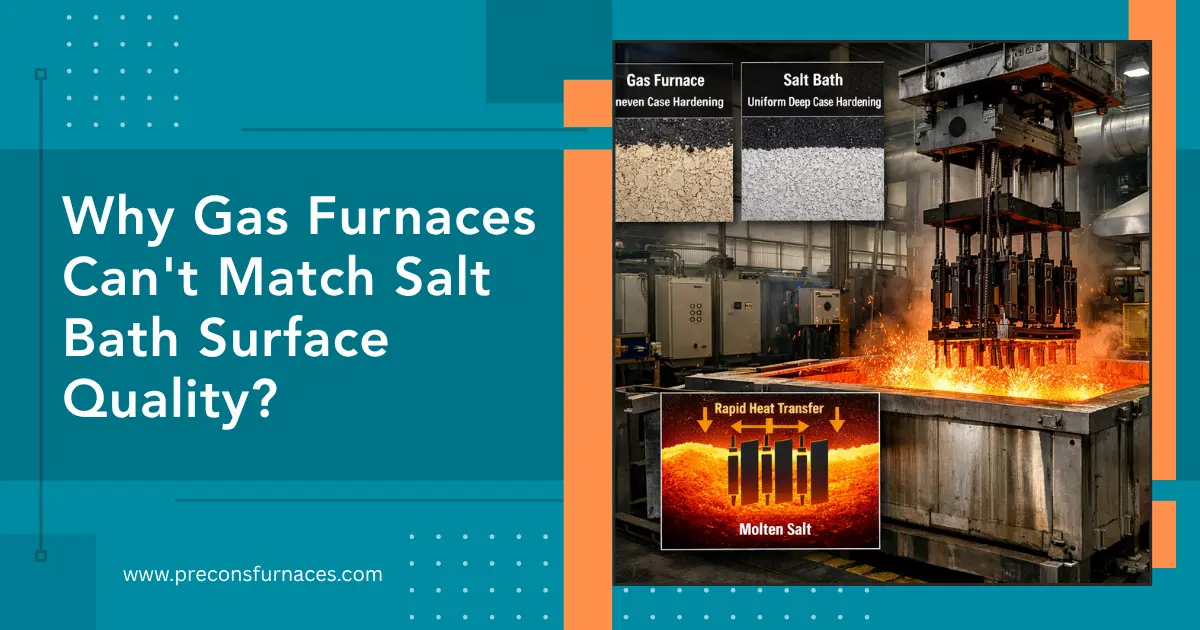
Unlike conventional furnaces that rely on air or atmosphere-based heating, salt bath furnaces immerse metal components directly into molten salt at controlled temperatures. This direct contact creates an environment where heat transfer is remarkably uniform and rapid — two critical factors that define the quality of surface hardening.
The result? Components exit the process with tighter metallurgical consistency, better surface integrity, and significantly reduced risk of cracking or warping.
Key Advantages of Salt Bath Furnaces for Surface Hardening
- Uniform Heat Distribution — Salt’s liquid nature surrounds every contour of the part, eliminating hot spots that lead to inconsistent hardness.
- Faster Heating Rates — Liquid salts conduct heat up to 5x faster than air, reducing cycle times without sacrificing quality.
- Minimal Oxidation & Decarburization — The salt bath acts as a protective barrier, preserving the carbon-rich surface layer that determines final hardness.
- Precise Temperature Control — Modern salt bath systems maintain temperatures within ±2°C, enabling repeatable, process-stable outcomes across high-volume production.
- Low Distortion — Because heating is so even, thermal shock is minimized, making this method ideal for complex geometries and thin-walled components.
Industries That Rely on Salt Bath Surface Hardening
Salt bath hardening isn’t a niche process — it’s a backbone of high-performance manufacturing. Sectors that depend on it include:
- Automotive — transmission gears, shafts, and precision fasteners
- Tool & Die Manufacturing — cutting tools, dies, and punches
- Aerospace — components requiring high fatigue resistance
- Medical Devices — surgical instruments demanding clean, consistent surface properties
The Science Behind the Superior Results
When a steel component is submerged in a carburizing or neutral salt bath, carbon atoms at elevated temperatures diffuse into the surface layer — a process known as case hardening. The depth of this case, known as the effective case depth (ECD), can be tightly controlled based on time and temperature parameters.
What sets salt baths apart is repeatability. Each batch behaves predictably, making it easier to maintain quality certification standards like ISO and NADCAP compliance.
Application-Specific Benefits
Tool and Die Manufacturing
Salt bath hardening delivers the edge retention and toughness tooling demands:
- Uniform hardness across complex cutting geometries
- Minimal dimensional change preserving critical tolerances
- Excellent surface finish reducing tool preparation time
Automotive Components
Drivetrain and engine parts benefit from:
- High-volume production capability processing hundreds of parts per hour
- Consistent quality batch after batch
- Wear resistance extending component service life
Choosing the Right Equipment Partner
Results are only as good as the equipment behind them. That’s why engineers and procurement teams trust Precons Furnaces — a name synonymous with engineering excellence in industrial heat treatment solutions. Their salt bath furnace systems are built for durability, precision, and process efficiency — giving manufacturers the confidence to meet even the most demanding specifications.
Ready to upgrade your heat treatment process? Explore Precons Furnaces and discover salt bath furnace solutions engineered for performance, precision, and reliability. In summary, salt bath furnaces deliver superior hardening results because they combine speed, uniformity, and process control in ways no other method can replicate. For operations where surface hardness is non-negotiable, this technology isn’t just an option — it’s the standard.