
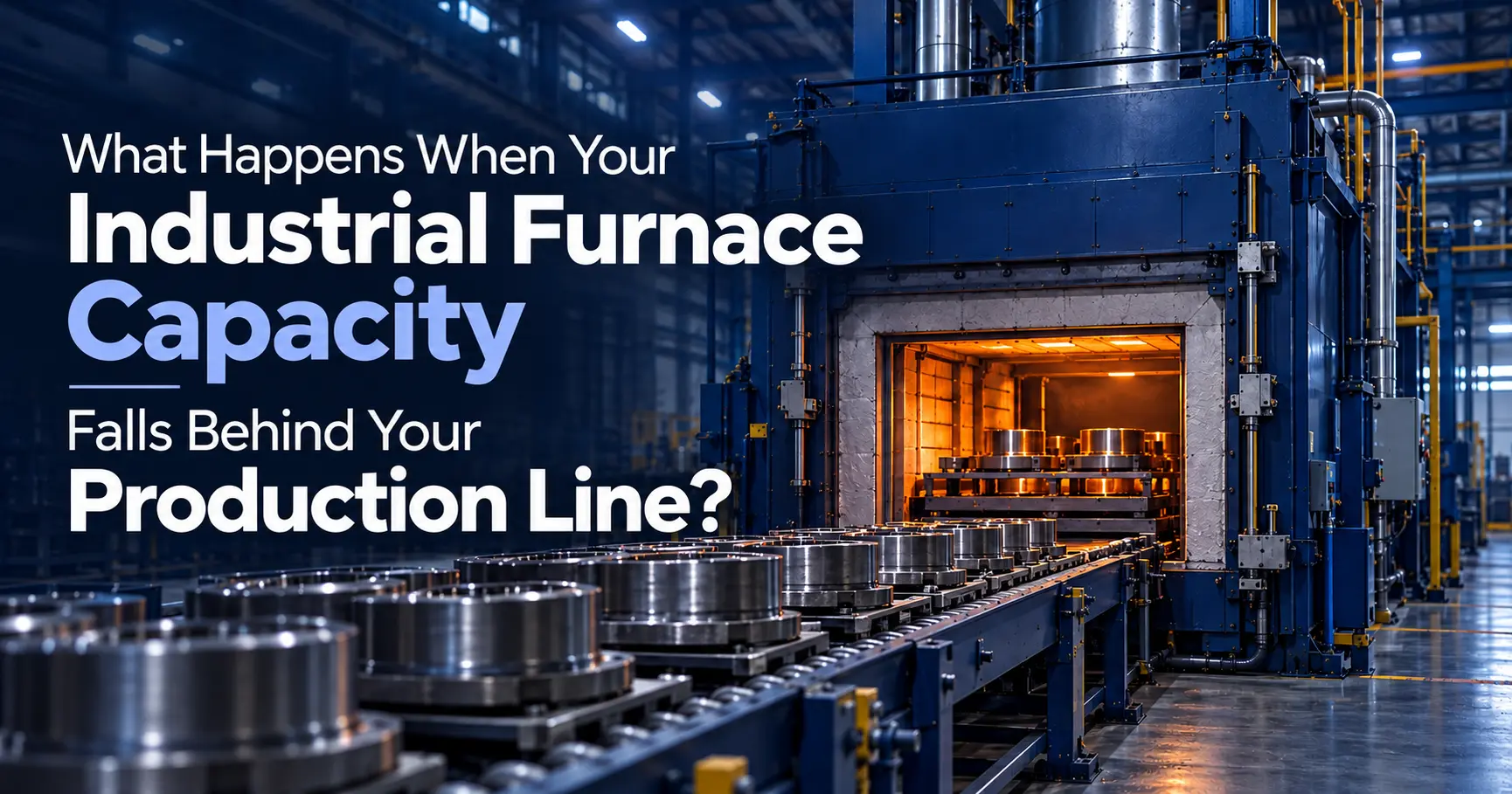
Manufacturing success often hinges on synchronized production capacity—every stage of your operation working in harmony. Yet one silent bottleneck frequently undermines this balance: industrial furnaces that can’t keep pace with upstream production improvements. When forging presses, stamping lines, or machining centres speed up while heat treatment capacity stays fixed, the entire operation suffers.
Understanding this capacity mismatch phenomenon helps manufacturers identify hidden constraints before they cripple production targets and customer commitments.
The Capacity Gap: How It Develops
Furnace capacity limitations rarely emerge suddenly. They develop through predictable business scenarios:
- Upstream equipment upgrades increasing feed rates beyond original furnace design
- New customer contracts demanding volumes exceeding current thermal processing capability
- Product mix changes requiring longer cycle times for different materials
- Facility expansion adding production lines without corresponding furnace capacity
- Seasonal demand spikes overwhelming furnaces sized for average, not peak, volume
The Cascading Consequences of Capacity Mismatch
Immediate Production Impacts
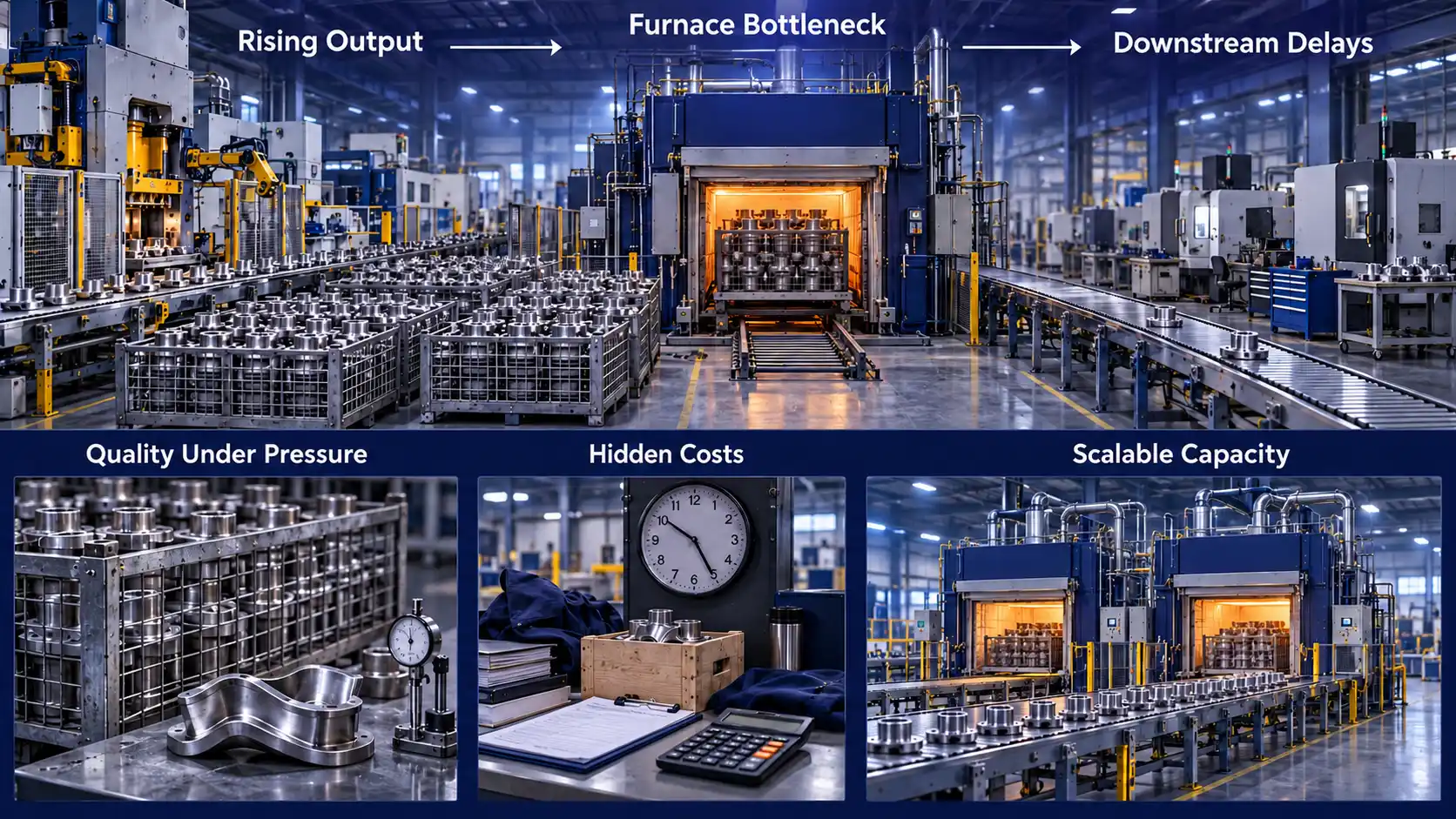
When industrial furnace throughput can’t match line speed, immediate operational problems emerge:
- Growing work-in-progress inventory as parts queue before heat treatment
- Idle downstream equipment waiting for processed components
- Extended lead times disappointing customers expecting faster delivery
- Overtime labour costs attempting to compensate for capacity shortfalls
Quality Compromises Under Pressure
Rushing furnace cycles to increase apparent throughput creates dangerous trade-offs:
- Reduced soak times compromising metallurgical properties
- Overloaded batches sacrificing temperature uniformity
- Skipped quality checks to maintain production pace
- Increased rejection rates from inadequate processing time
Recognizing the Warning Signs
Operational Indicators
Facilities approaching capacity crisis typically show:
- Consistently full furnace loads with no scheduling flexibility
- Growing queue times between upstream processing and heat treatment
- Increasing overtime hours dedicated specifically to furnace operations
- Scheduling conflicts between different product priorities
Strategic Business Signals
Leadership should watch for:
- Sales team hesitation quoting delivery times due to furnace constraints
- Declined order opportunities citing capacity limitations
- Customer complaints specifically about delivery consistency
Solving the Capacity Equation
Short-Term Mitigation Strategies
- Optimized scheduling algorithms maximizing existing furnace utilization
- Extended operating hours including weekend or overnight cycles
- Process cycle optimization reducing unnecessary soak time without compromising quality
Long-Term Strategic Solutions
Sustainable capacity resolution requires structural investment:
- Additional furnace capacity matched to realistic future growth projections
- Continuous processing systems replacing batch operations for higher-volume applications
- Modular furnace configurations enabling scalable capacity expansion
- Multi-chamber systems providing parallel processing capability
Hidden Financial Drain
Capacity constraints generate costs far beyond obvious production delays:
| Impact Category | Hidden Cost Driver | Typical Business Effect |
|---|---|---|
| Inventory Carrying Costs | WIP accumulation before furnace | Increased working capital tied up |
| Overtime Premiums | Extended shifts to compensate | 25-50% higher labor costs |
| Expedited Shipping | Compensating for delayed output | 15-30% premium on logistics |
| Quality Rework | Rushed cycles causing defects | Material waste + reprocessing time |
| Customer Penalties | Missed delivery commitments | Contract penalties, lost future orders |
| Opportunity Cost | Declined orders due to capacity fear | Lost revenue from turned-away business |
Key Insight: The True Cost of Underinvestment
Manufacturers frequently underestimate capacity constraint costs because expenses appear scattered across multiple budget categories rather than as a single line item. When calculated comprehensively—including overtime, expedited shipping, quality costs, and lost opportunities—capacity-related losses often exceed the investment required for additional furnace capacity within 12-18 months.
Making the Capacity Investment Decision
Evaluating furnace capacity expansion requires analyzing: current utilization rates versus theoretical maximum capacity, realistic 3-5 year growth projections, total cost of constrained capacity versus expansion investment, and flexibility requirements for future product mix changes.
Is furnace capacity limiting your production potential? Precons Furnaces engineers scalable furnace solutions—from continuous line systems to modular configurations—designed to match and grow with your production demands. Our engineering team helps manufacturers eliminate capacity bottlenecks before they impact customer commitments.
Don’t let furnace capacity silently cap your growth potential. [Request a Schedule for Consultation] – Our engineers will evaluate your current production flow, identify exactly where furnace capacity constraints are costing you money, and recommend the right-sized solution to match your production line’s true capability.